

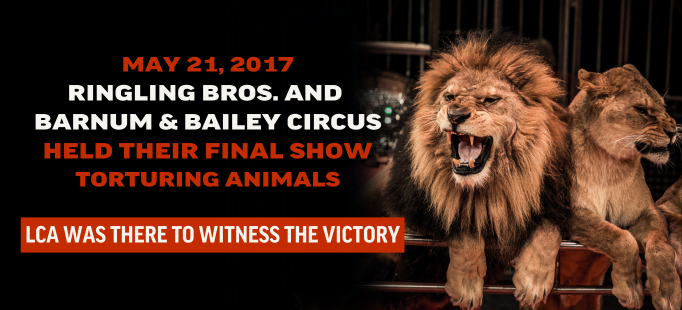
RINGLING BROS. AND BARNUM & BAILEY FINAL ANIMAL SHOW - MAY 21, 2017
On May 21, 2017, Ringling Bros. and Barnum & Bailey Circus held their final show with animals after 146 years. The show was held in Uniondale, New York, and LCA's President & Founder, Chris DeRose, led the demonstration to celebrate the momentous victory for the animals. This marked the end of a cruel era of Ringling Bros. breeding animals or stealing them from the wild, and forcing them to perform demeaning and unnatural tricks out of fear.
The end of Ringling Bros. was a hard-won victory that followed decades of investigations and protests by LCA and other animal advocacy groups. The demonstration at the final show commemorated the occasion as well as urged Ringling to send the animals to sanctuaries and not sell them to zoos or other exploitative facilities.
For decades, LCA has been at the forefront of undercover investigations and nonstop protests that garnered international attention exposing the severe animal cruelty that Ringling so desperately tried to hide and deny.
Ringling’s CEO, Kenneth Feld, sent one of his own investigators, Steve Kendall, to spy on LCA's President, Chris DeRose. That move backfired as the investigator ended up “flipping” and worked with LCA after realizing the cruelty involved in Ringling’s training tactics.
Steve Kendall was hired by Feld and worked for him for 8 years gathering information about leaders of the animal rights movement, but ended up helping LCA by supplying intel against Ringling.
“Anyone that gets in Kenneth Feld’s way, he investigated. Chris DeRose was a threat, one of the biggest. Kenneth singled out individuals that targeted the shows and looked for other ways to combat them, trying to shut down those people and organizations (LCA, PETA) economically,” states Mr. Kendall.
LCA’s undercover investigator exposed some of the most egregious acts by trainers of circus elephants in the 15 years he worked for LCA, at serious risk to his own life.
It has been widely documented that Feld Entertainment employed unscrupulous tactics to obtain and train its performing animals:
- Stealing infants from their mothers. An estimated 50 percent of the Asian elephants owned by Ringling were captured and torn from their families in the wild
- Using bullhooks, ropes, and electric prods to forcibly train animals to perform demeaning, unnatural, ridiculous tricks out of fear and domination
- Failing miserably to meet even minimal federal standards of care for the animals
- Entrapping animals for up to 11 months on the road in cramped, filthy boxcars and trailers
Succumbing to the nonstop outcry against the use of elephants in the circus, Ringling finally ended its elephant act in May of 2016. LCA, along with dedicated supporters and activists, kept up the fight, demanding an end to the use of all the animals. Because of actions like LCA’s, ticket sales dropped dramatically.
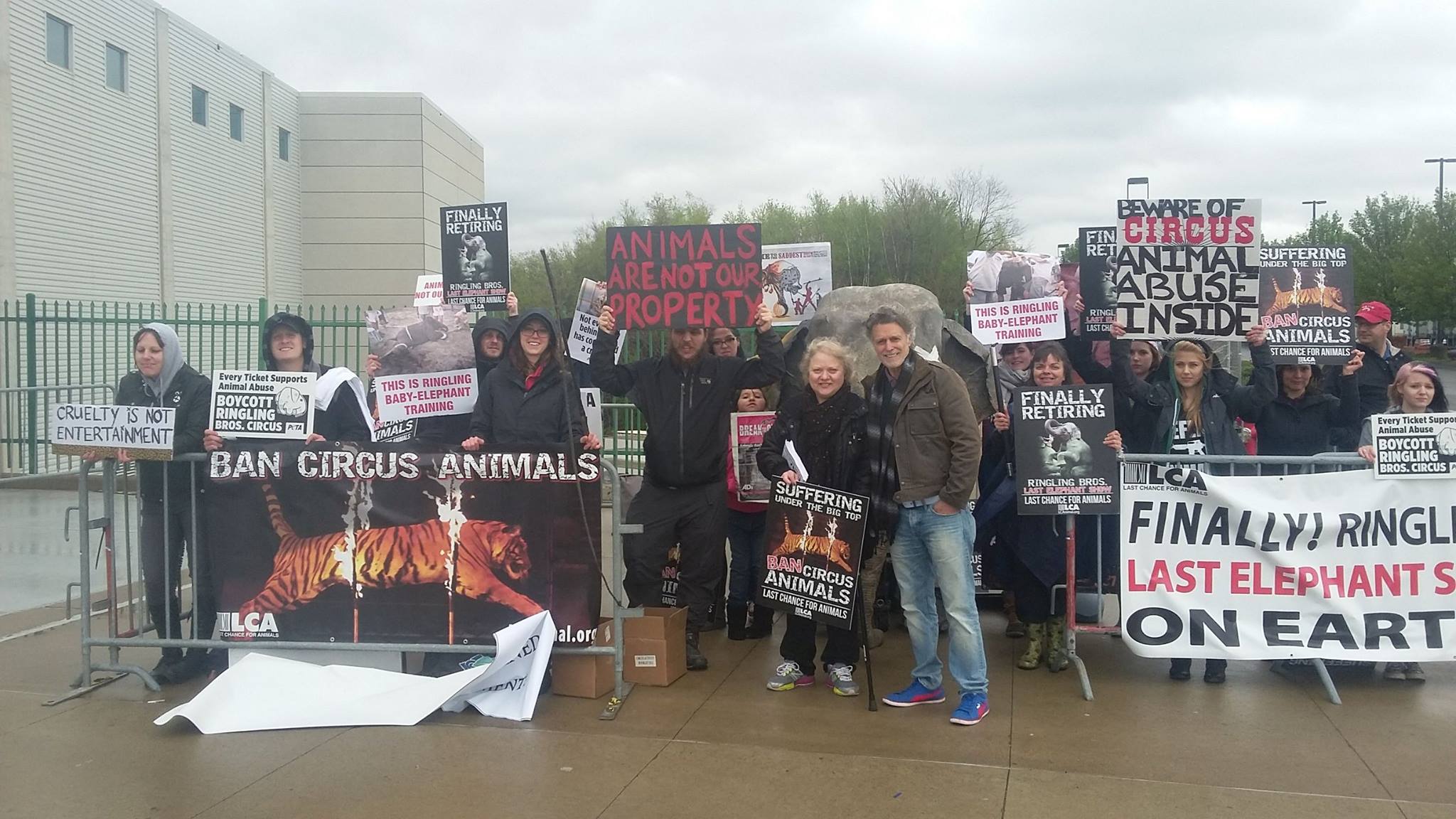
Chris DeRose leads the protest outside Ringling Bros. last elephant show
On behalf of the animals, we are ecstatic about this victory. Ringling fought to continue the circus despite the continuous exposure of animal cruelty and public outcry. It’s been a long, grueling battle, but LCA always knew that we would prevail and make a difference.
LCA thanks all of you who protested, signed petitions and wrote letters as we fought for this hard-won victory. Together, real change has been made for Ringling's circus animals and it would not have happened without you!
Thank you for helping to end Ringling’s brutal treatment of animals. LCA will keep up the fight until no more animals suffer in the name of entertainment!
In the News May 2017: Read Los Angeles Times Op-ed written by LCA's President, Chris DeRose
LA Times: Click Here
VICTORY: California bans the use of wild and exotic animals in circuses!
On October 12, 2019, Governor Newsom signed SB 313 (the Circus Cruelty Prevention Act) into law, banning the use of bears, tigers, monkeys, elephants, and other wild animals in circuses statewide.
Animal Cruelty at Circuses
ABOUT CIRCUSES
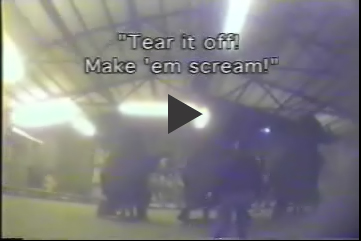 Watch the undercover footage that aired on California’s KCAL-9 News.
Circus animals do not willingly stand on their heads, jump through rings of fire, or ride bicycles. They don’t perform these tricks because they want to and they don’t do any of these meaningless acts in their natural habitat. The ONLY reason circus animals perform is because they are scared of what will happen to them if they don’t.
The circus would like you to think that these intelligent and sentient creatures perform because they are positively reinforced with food, praise, etc. There is no such thing as positive reinforcement for animals in the circus - only varying levels of punishment, neglect, and deprivation. These animals have limited access to food and water as to will them to perform, as well as to prevent untimely defecation and urination while they are on stage or in public view.
An LCA investigator went undercover inside the Carson & Barnes Circus, where he documented extreme animal abuse, including elephants being beaten with baseball bats, pitchforks, and other objects; shocked with electric prods; and hit on the head and across the face. LCA worked with local media to expose this cruelty and filed a complaint with the United States Department of Agriculture.
CRUEL TRAINING
Training circus animals involves physically punishing them. These training practices generally will be hidden from public view to make the audiences believe these animals want to and are willing to perform. Because these animals have been conditioned through violent training sessions, they know that refusal to obey in the ring will result in severe punishment later. Moments before entering the ring, while just outside of public view, trainers may give the elephants painful whacks or blows to remind them who’s in control and to ensure that the elephants perform the specified tricks on command.
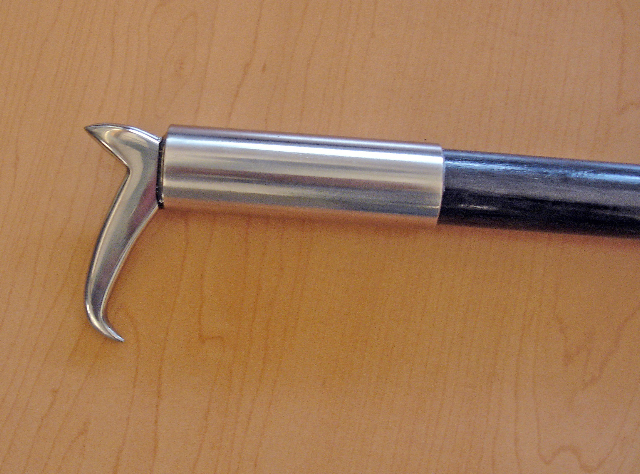
Animals in the circus are routinely whipped, beaten with long metal rods, shocked with electric prods, and struck with clubs. Trainers often strike elephants with a bullhook or an ankus on the sensitive areas of their skin such as around their eyes, under their chin, inside their mouth, and behind their knees and ears. A bullhook is also sometimes used to hit animals across the face. Bears have their noses broken and their paws burned to teach them to walk on their hind legs. Carson & Barnes trainers have even been documented using blowtorches on elephants. Circuses easily get away with these cruel practices because no government agency monitors training sessions.
 |
 |
|
Bullhook |
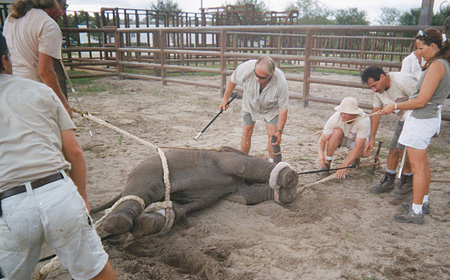
Ringling elephant farm training |
A number of animals are even drugged to make them more manageable. Others have their teeth removed; one group of chimpanzees had their teeth knocked out by a hammer. Ringling Bros. and Barnum & Bailey Circus use some of the worst training practices with elephants ever documented. Elephants have a very similar life cycle to humans and they care for their young much like we do. These captive elephants are forced to breed as young as 8 years old, that’s like breeding an 8-year-old child. After the mother gives birth, tied by 3 legs the entire time, the babies are taken away immediately which causes the mother severe duress. Ringling Bros. chains the mother by all 4 legs to take the baby away so that the mother elephant won’t be able to hurt the trainers. Even before being weaned these baby elephants are put in a separate area from their mothers and are then chained for up to 23 hours a day. In the wild, elephants often nurse their babies until five years of age. Then the “correction process” for the baby elephants starts where they are tied up and beaten repeatedly to break their spirit. This training process is so brutal, that Ringling Bros. WILL NOT let their own PR department film the training of these baby elephants.
ONGOING CONFINEMENT
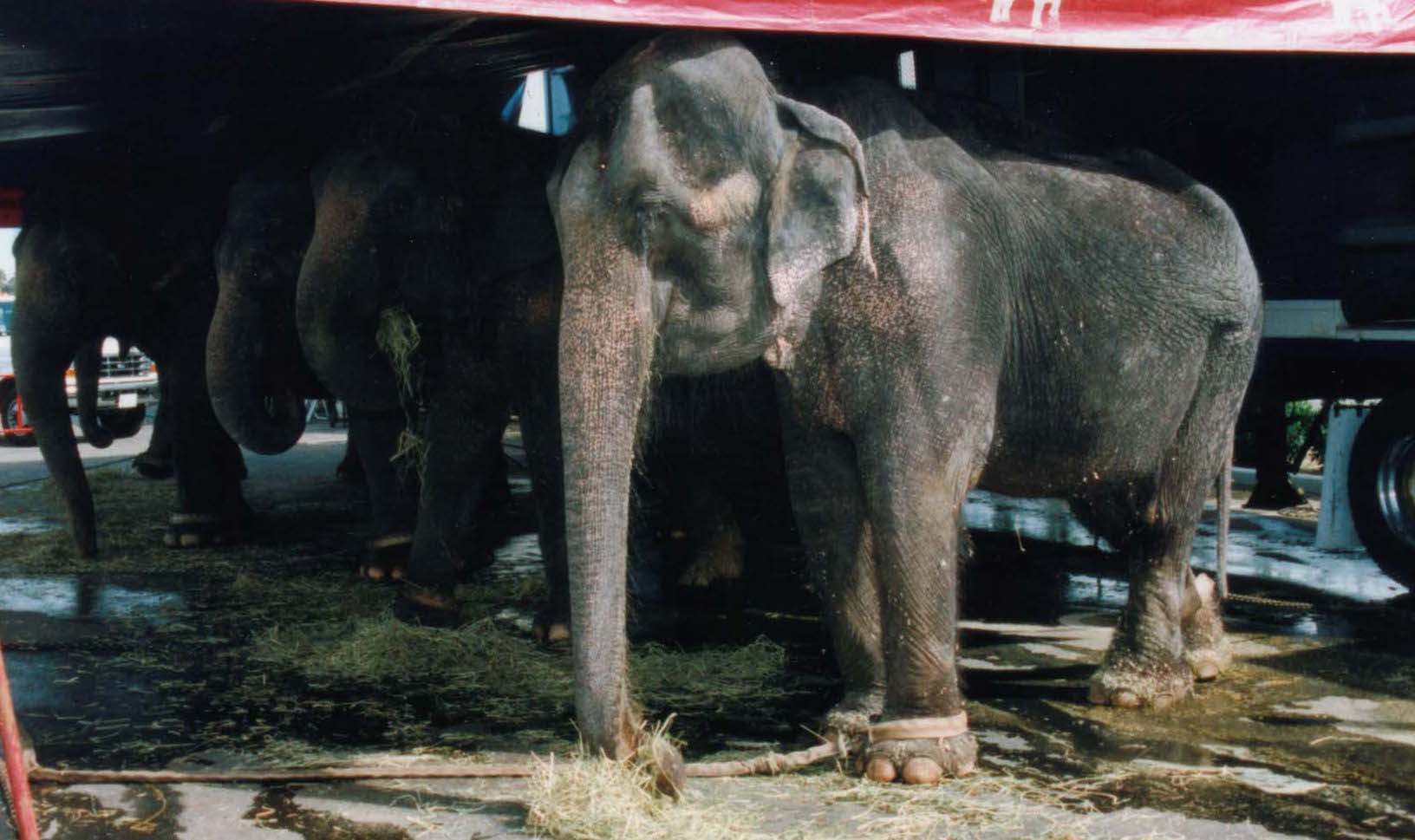
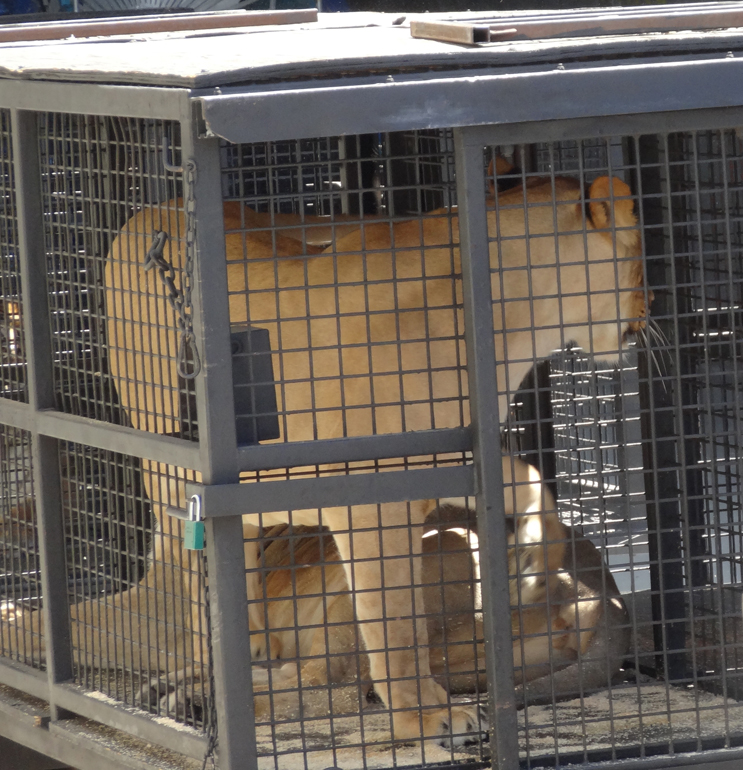
Ongoing travel means that circus animals are confined to boxcars, trailers, or trucks for days at a time in extremely hot and cold weather, often without access to basic necessities such as food, water, and veterinary care. Elephants, primates, big cats, and bears are confined to cramped, filthy cages in which they eat, drink, sleep, defecate, and urinate- all in the same place. The climates circus animals encounter during their exhaustive travels are often very different than that of their natural habitats. Bears are forced to endure extreme heat in the summer, and sometimes even walk across hot concrete on their way into the performing arena. Lions, on the other hand, find the cold very difficult to bear; some circus animals freeze to death.
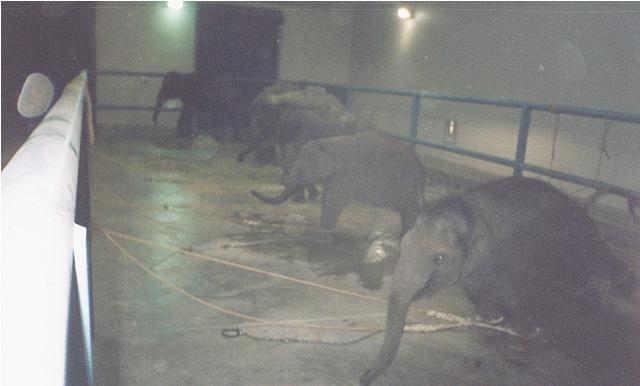
The majority of circus elephants are captured in the wild. These wild elephants walk as much as 40 miles a day while in their natural habitat. Once captured, they are chained in one place for up to 23 hours a day. Ringling Bros. and Barnum & Bailey Circus brag that it’s three units travel more than 25,000 miles as the circus tours the country for 11 months each year. Ringling Bros. own documents state that on average, elephants are chained for more than 26 hours straight and are sometimes continually chained for as many as 60 to 100 hours. When the animals arrive at their next destination, instead of being let off the railway cars immediately after arriving at the arena, they are sometimes forced to remain inside for hours despite extreme temperatures.
 |
 |
|
Two large cats in cramped cage at Ringling Bros |
Baby elephants chained at Ringling's elephant farm |
ABNORMAL BEHAVIOR
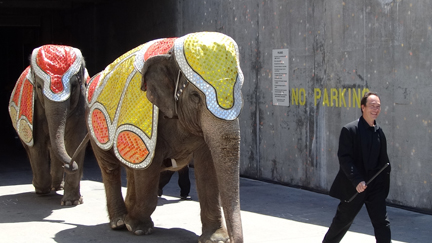 Ringling elephants and trainElephants are very social creatures and they form tight bonds with their families and other elephants. They feel joy, compassion, sadness, and grief just like humans do. Many circus animals become dysfunctional, unhealthy, depressed, and aggressive as a result of unnatural and unrelenting confinement in which they are kept and treated. When these elephants have their babies taken away, that lifelong relationship is abruptly terminated and every moment, every natural instinct, and every natural behavior is subject to discipline.
Some signs of abnormal behavior found in captive elephants include rocking, swaying, head-bobbing, or other repetitive movement. These behaviors are signs of extreme psychological distress. Elephants who are breathing with their mouths open are usually in pain. Captive large cats and bears pace back and forth and some bears have been known to beat their heads against their cages. Bar biting and self-mutilation are also common among circus animals and is directly related to the stress caused by confinement.
PUBLIC SAFETY AND EDUCATION
Wild animals behave instinctively and unpredictably. Circus animals have run amok through streets, crashed into buildings, attacked members of the public, and killed and injured handlers.
Additionally, some circus elephants have been diagnosed with a human strain of Tuberculosis (TB) and have passed it on to their handlers. Elephants in circuses are predisposed to TB because of routine transport that often exposes them to other infected elephants and because of stress factors, including severe punishment, constant confinement, inconsistent water quality and food supply, and poor nutrition. TB is an airborne disease which spreads through tiny droplets in the air. If TB is diagnosed in an elephant there are clear public health implications as the disease can be spread by close contact with infected animals and people. Circuses often allow members of the public to feed, pet, and ride the elephants which put them at great risk.
Observing circus animals teaches the public and children nothing about the natural behaviors of the animals. A lot of people mistakenly believe that captive breeding will help elephants and other species from becoming extinct. However, elephants that are born in the breeding centers of circuses can never be returned to the wild. Ringling Bros. and Barnum & Bailey Circus operate under the umbrella of conservation. Ringling Bros. built a property in Florida that is known as “The Center for Elephant Conservation”. This “farm” is not open to the public. A former worker at Ringling’s elephant farm became a whistleblower on their training methods and took pictures and videos detailing the abuse. Gary Jacobson, the general manager of Ringling’s elephant farm, was filmed roping all four legs of baby elephants and then stretching their legs in every direction to force them to the ground and break their spirits.
LCA SPEAKING UP FOR CIRCUS ANIMALS
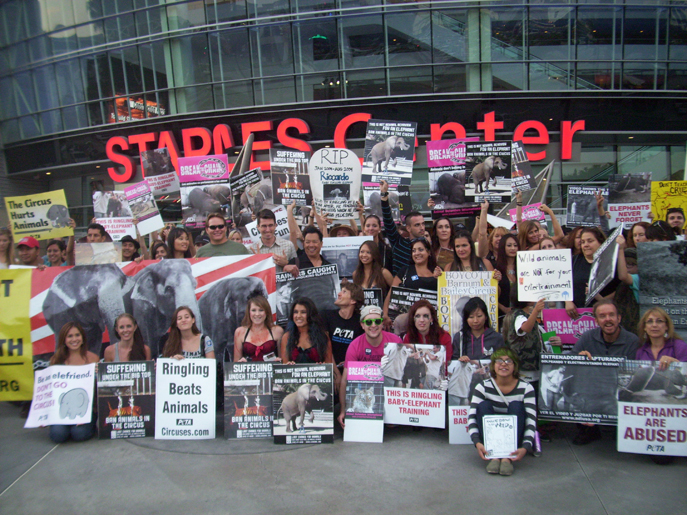
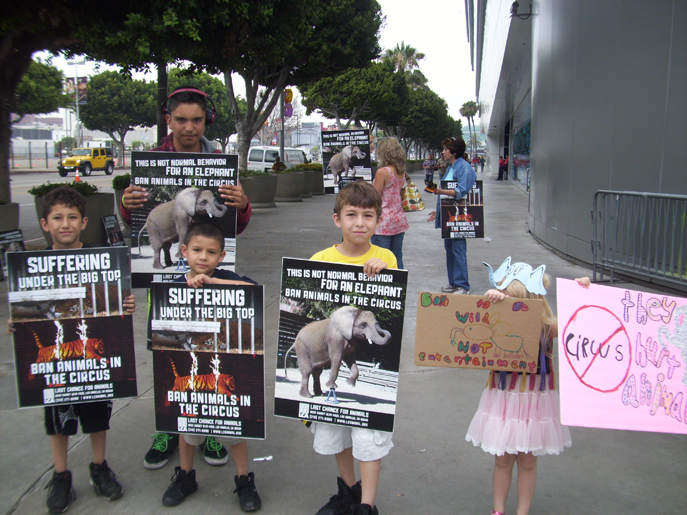
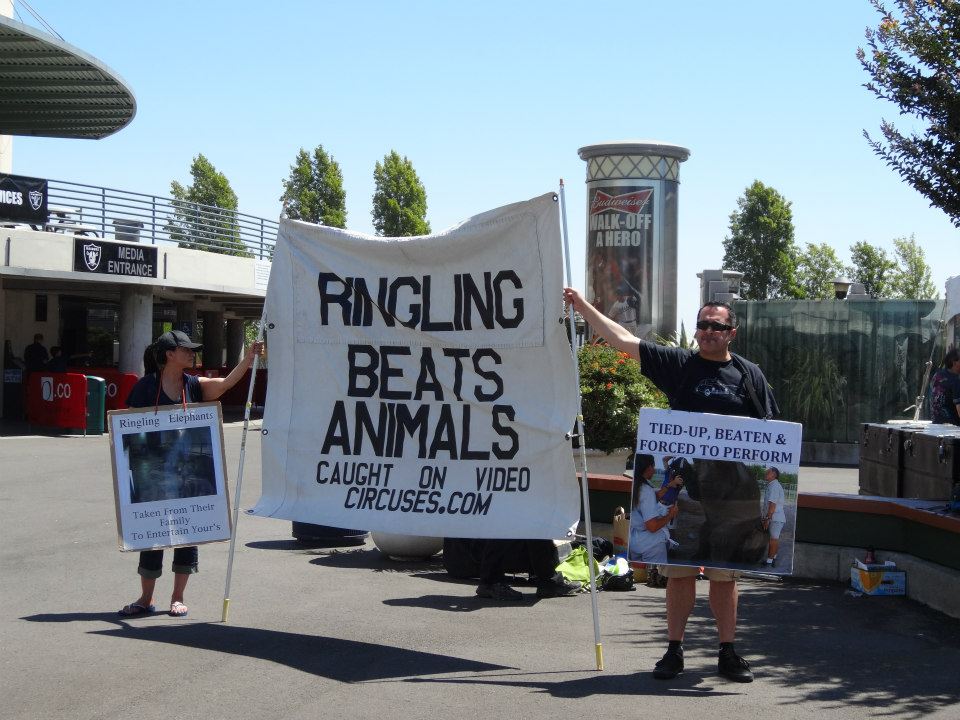
LCA and animal activists have protested Ringling Bros. and Barnum & Bailey circuses throughout the United States. LCA’s campaign against animals in circuses is dedicated to educating the public about the abuse circus animals suffer and working to get current footage and information to put an end to traveling animal circuses.
 |
 |
 |
 |
LCA needs volunteers to attend protests and to help film and photograph the circus. To volunteer, click here.
WHAT YOU CAN DO TO HELP
• Do not visit circuses that use animals.
• Write to circus sponsors and tell them you do not want to see wild animals in circuses, for the sake of the animals and the public.
• Write letters to editors of local newspapers asking sponsors to stop supporting the circus.
• Organize or attend a protest.
• Support legislation protecting circus animals.
• Report any possible violations of state and local animal protection laws to the police and animal control.
CIRCUSES THAT DO NOT USE ANIMALS (PARTIAL LIST)
Cirque du Soleil, The New Pickle Family Circus, Bindlestiff Family Circus, Circus Millennia, Circus Smirkus, Cirque Eloize, Circus Oz, Mexican International Circus, Cirque Ingenieux, Earth Circus, Fern Street Circus, Little Russian Circus, Neil Goldberg's Circus, Circus Vargas